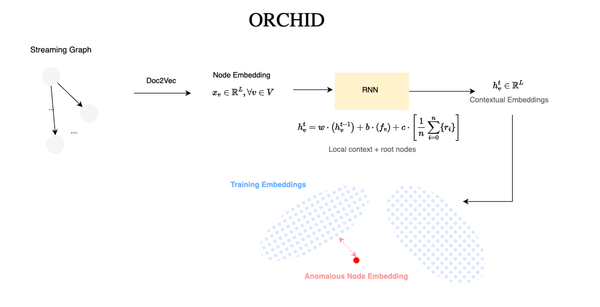
During the last few months, I spent a significant amount of time reviewing system modeling literature and exploring the current advancements in this area of research. Specifically, my goal was to apply advanced machine learning including deep learning techniques to efficiently represent system events in a euclidean space and detect

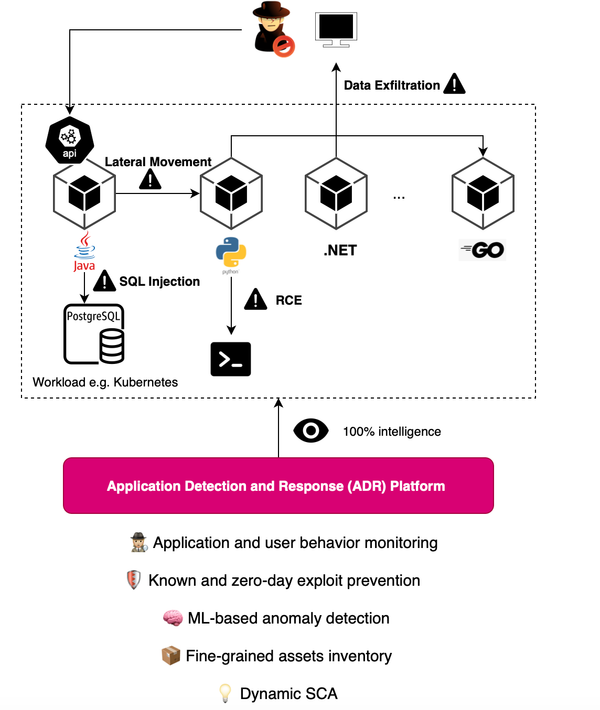
Few companies are starting to pave the way for Application and Detection Response (ADR) including Oligo Security, RevealSecurity and Miggo Security. You may find yourself quickly lost in understanding what these solutions aim to tackle. First, each of these solutions likely focuses on what they do best. For example, Oligo
Large Language Models (LLMs) have evolved from being merely passive text generators with limited capabilities to becoming autonomous or semi-autonomous agents navigating complex environments and offering actionable insights. This transformation equips them with a diverse set of tools, perception modules to interpret signals from various modalities, and memory systems
Multimodal Large Language Models (MLLMs) are garnering significant attention. There has been a plethora of work in recent months dedicated to the development of MLLMs [Flamingo, NExT-GPT, Gemini...]. The key challenge for MLLMs lies in effectively injecting multimodal-data in LLMs. Most research begins with pre-trained LLMs and
Large Language Models (LLMs) are developed to understand the probability distribution that governs the world language space. Autoregressive models approximate this distribution by predicting subsequent words based on previous context, forming a Markov chain. World knowledge (often referred as parametric knowledge) is stored implicitly within the model's parameters.
Large Language Models (LLMs), exemplified by OpenAI’s GPT-4 and Meta’s LLaMA, continue to impress us with their capabilities, which have surpassed expectations from just a few years ago. Recently, the research community has shifted its focus towards the optimal and efficient usage of resources. Concepts like the
Transformer-based deep learning models, such as GPT-3 and LLaMA, have achieved state-of-the-art results on many NLP tasks. These models have exhibited outstanding performance and are capable of resolving tasks on the fly through in-context-learning (ICL) without the need for retraining. This approach helps
The urge to train expansive deep learning models, particularly large language models, is ever-growing. A single GPU often falls short in providing the required memory capacity to accommodate various parameters and data, thus necessitating the employment of multiple GPUs. Additionally, the time cost of training complex models can be
Scaling up the size of models leads to a considerable augmentation in computational expenses, both during training and inference phases. In a bid to harness the benefits of parameter scaling without an equivalent surge in computational requirements, the Mixture of Experts (MoE) approach was developed for expansive language models. Within