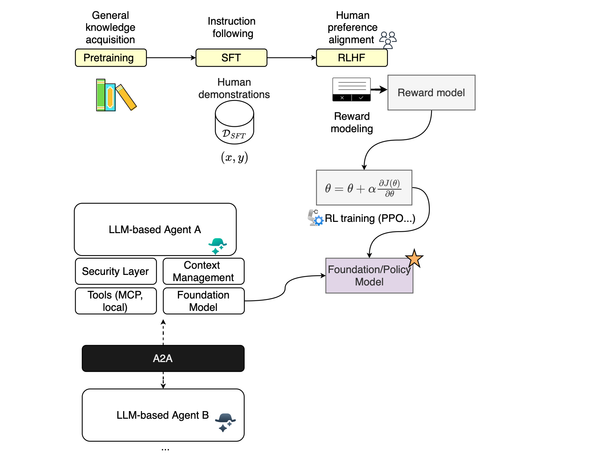

The goal of this post is to briefly present how multi-agent systems emerged by looking at some of the history and the cognitive backbone of AI or LLM-powered agents. An autoregressive language model, which will be denoted as \(p_\theta\) (or \(\pi_\theta\) in RL terminology), is a

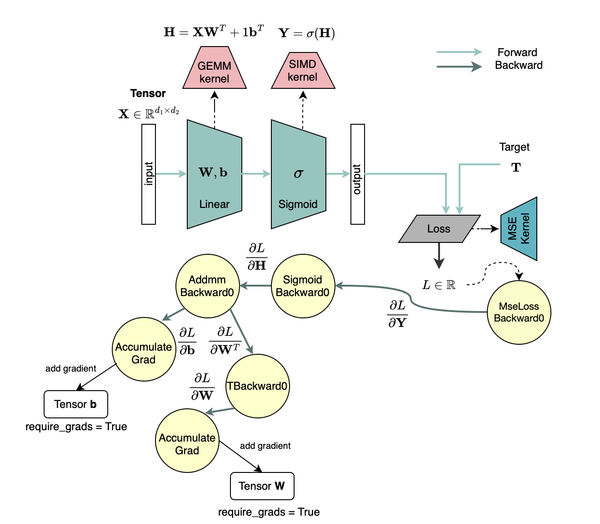
Deep learning has reshaped the landscape of machine learning. It achieved overwhelming advantages across diverse domains, from image classification, video and text generation, to enabling multi-agent development (agents use foundation autoregressive models trained with SGD as their brains). In order to reduce the cognitive burden on practitioners, the inner
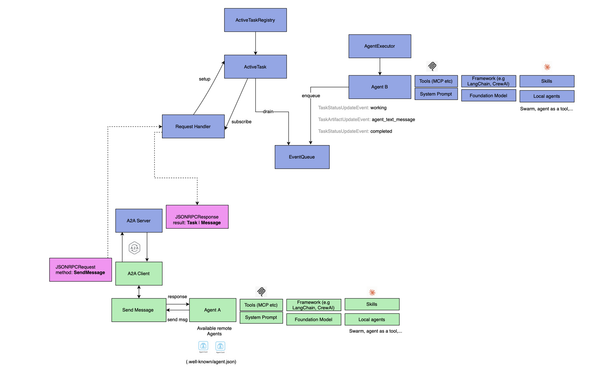
The goal of this post is to provide an in-depth look at standardizing how heterogeneous agents discover, authenticate, and communicate with one another by examining the Google's Agent-to-Agent (A2A) protocol [1] (covering both theory, practical deployment and security). The post will present the foundations of
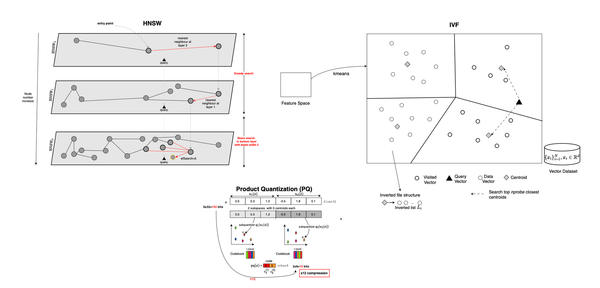
The goal of this post is to explain how vector similarity search works internally. Why is this interesting? Because Retrieval-Augmented Generation or RAG is typically implemented using vector search over text embeddings. Embeddings are basically a bottleneck that compresses the semantics of a paragraph or chunk into a continuous
This post summarizes the main implementation patterns used by modern multi-agent frameworks including agents-as-tools, handoffs, routing, reflection, group chat, debate, Magentic-style ledger orchestration, dynamic subagent spawning, and mixture-of-agents architectures. The Brain: Foundation Models Well, the first thing we need to build an agent is
Introduction A straightforward approach to augment large language models or LLMs with new capabilities is through in-context learning. The model is provided with a small number of examples that demonstrate how to solve a task, after which it generates a response using its inherent capabilities combined with the knowledge
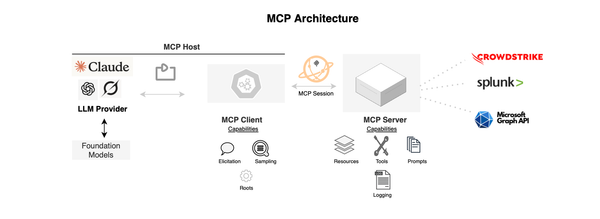
Whether you are an AI engineer or working on workflow automation, you probably know how much attention the MCP or Model Context Protocol has attracted recently; thanks to the AI hype cycle. Since its introduction by Anthropic, it has gained real momentum, supported by a vibrant community ecosystem with thousands
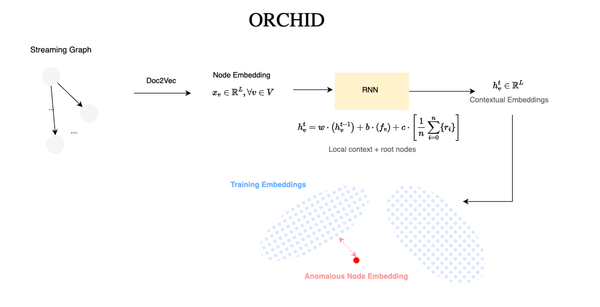
During the last few months, I spent a significant amount of time reviewing system modeling literature and exploring the current advancements in this area of research. Specifically, my goal was to apply advanced machine learning including deep learning techniques to efficiently represent system events in a euclidean space and detect
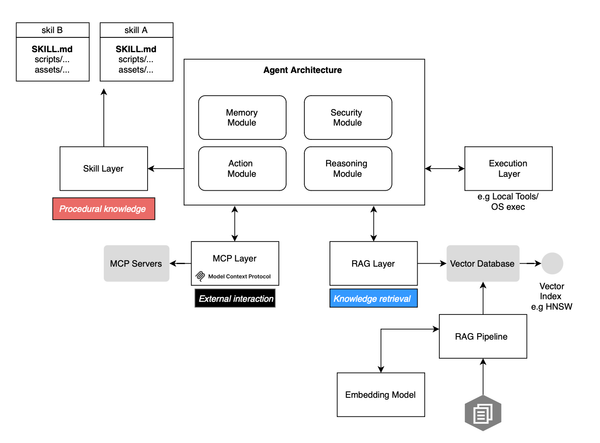
Large Language Models (LLMs) have evolved from being merely passive text generators with limited capabilities to becoming autonomous or semi-autonomous agents navigating complex environments and offering actionable insights. This transformation equips them with a diverse set of tools, perception modules to interpret signals from various modalities, and memory systems